

Fallas | Valencia’s Biggest Festival
There is no festival bigger in Valencia than the Fallas (or Falles in the Valencian language). Or for that matter, and from what we’ve learned so far, no other festival in the world is as amazingly creative and imaginative! Every year in March, the entire city is overtaken by spectacular art installations that transform every neighborhood. It reaches beyond the city and is also celebrated in practically every town, large and small, throughout the community of Valencia. If you’ve never heard of it, be prepared to be astounded at what it entails. In the hopes of getting your attention, let’s start you out with one word – fire (fuego)! Okay, let’s go from there.
Top Image – Image credit to City of Valencia
What is the Fallas Festival About?

Above Image – Fallas Image credit to the City of Valencia.
We experienced the Fallas festival for our first time in 2016, in the community’s capital city of Valencia. This is a festival that is worked on year-round by the locals who are involved. It’s a deeply important tradition, involving artists and builders, the Falleras and Falleros, and countless others. The cities and towns of the entire Valencia Community are overtaken by these celebrations, and not just for a day or two. We’re talking weeks here!
The root of the Fallas tradition is celebrating the impernance and that nothing last forever. It originally started back in the 18th century as a carptenter’s tradition. They would herald in the arrival of Spring on the 19th of March by burning the pieces of wood used to prop up their lights. Over time, it evolved into building giant effigies and began to be satirical.
So now, neighborhoods groups called casals work all year to build their particular Falla around a certain theme they choose. Then on the night of March 19th, they burn it to the ground! I’m not kidding you. And these are placed in the intersection of streets throughout the city.
What Traditions are Part of Fallas?

Each year, the Fallas Festival starts on the last Sunday of February 28th with the Crida. This is the official grand beginning to the festival and features an incredible fireworks display at the Torres de Serranos. The festival then goes until March 19th.
Starting March 1st, the Mascleta takes place every day at 2pm in the Plaza de Ayuntamiento. Two of the most important dates are March 15th for the Plantà, which is when the Fallas are assembled. Then the biggest event of all is the Cremà on the evening of March 19th. This is when all the Fallas are burnt!
Why Enjoy the Fallas?

We really enjoy the Fallas, especially as creatives who love art, design, and of course Valencia. Even around the beginning of February, you can start to see evidence of the set-up beginning for Fallas. This is mainly things like overhead, heavy-duty spotlights in areas where the Falla monuments and ninots are going to go.
So, get ready and excited with us for the celebratory noise, handmade larger-than-life magical characters, fireworks, food and drink. And let’s not forget to mention the traditional garb, processions and parades, and of course, the ultimate climax of the whole festival – the burning of the fallas!
READ MORE: Fallas in Valencia, and Our ‘Falla’ About It
Get a Glimpse of the Fallas Museum in Valencia
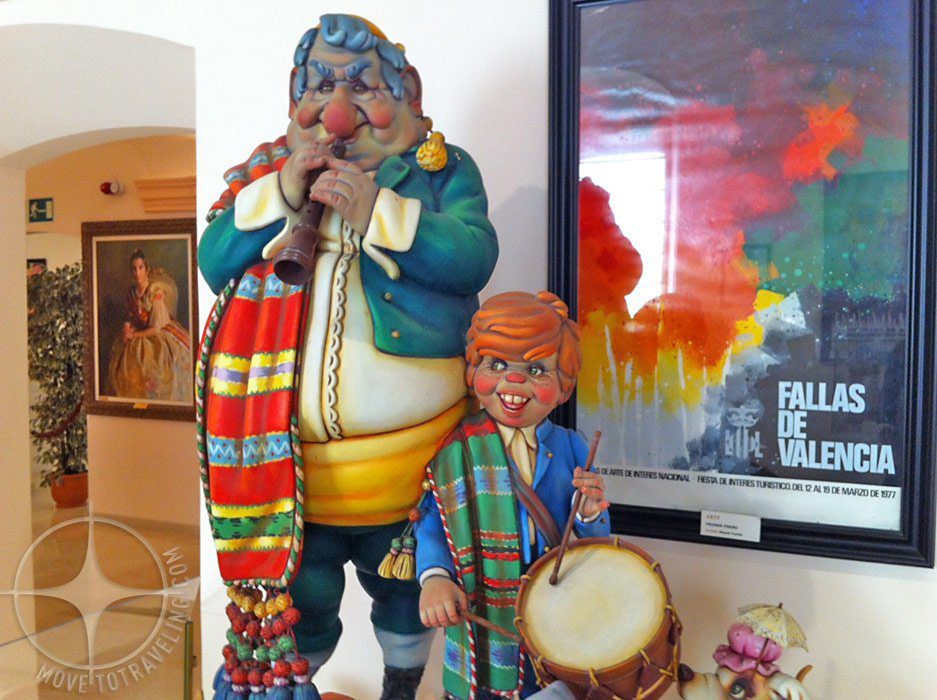
If you’re in Valencia, make sure to visit the Fallas Museum, which can be enjoyed year-round. You’ll be able to learn more about the history and to see the winning Falla, from which one figure is saved from the flames each year.


We're On GPSmyCity App


Created by Amalia & Eric
Founders & Producers of Move to Traveling
We’re Amalia and Eric – a traveling couple who moved from the US to Denia, Spain. With our combined skills of travel consultant/writer and artist/film producer, we share resourceful stories to inspire and support your travel dreams. Let us know how we can be of help.
0 Comments